For small businesses, generating consistent website traffic and qualified leads can be challenging, especially when the marketing budget is limited. Two of the most effective ways to increase visibility on Google are SEO and Google Ads. But which one should a small business choose?
The answer depends on your goals, budget, competition, customer journey, and how quickly you need results. SEO vs Google Ads is not always an either-or decision. SEO can help build long-term organic visibility, while Google Ads can provide faster exposure through paid search.
Understanding how both strategies work can help you decide where to invest your marketing budget and which approach is more suitable for your business.
Why SEO and Google Ads Matter for Small Businesses
Small businesses need marketing channels that can generate visibility without wasting valuable resources. Google is particularly important because customers often use search engines when they are researching products, comparing services, or looking for businesses they can contact.
SEO helps businesses appear in organic search results by improving website relevance, content, technical performance, and authority. Google Ads allows businesses to pay for targeted placements when potential customers search for relevant keywords.
A strong search marketing strategy can help a small business:
- Increase website visibility
- Reach customers actively searching for products or services
- Generate qualified leads
- Build brand awareness
- Increase website traffic
- Improve customer acquisition
- Create opportunities for long-term growth
The right approach depends on whether your priority is immediate results, long-term visibility, or a combination of both.
1. Understand How SEO Works
Search Engine Optimization (SEO) is the process of improving a website so that it can achieve better visibility in Google’s organic search results.
SEO focuses on attracting organic traffic without paying Google for every click. It can include keyword research, content creation, on-page optimization, technical SEO, internal linking, backlink building, local SEO, and user experience improvements.
For example, a digital marketing agency could target keywords such as:
- SEO services for small businesses
- Digital marketing agency in Delhi
- Local SEO services
- SEO consultant for small business
When a website earns strong organic rankings, it can continue attracting relevant visitors over time. However, SEO usually requires consistent effort and does not guarantee immediate rankings or traffic.
2. Understand How Google Ads Works
Google Ads is Google’s paid advertising platform that allows businesses to display advertisements when people search for relevant keywords.
Businesses create campaigns, select keywords, define audiences and locations, set budgets, and create advertisements. Depending on the campaign, businesses can pay based on clicks, impressions, or other advertising actions.
For example, a local plumbing company could target searches such as:
- Plumber near me
- Emergency plumber in Delhi
- Plumbing services near me
- 24-hour plumber
Google Ads can provide immediate visibility once a campaign is approved and running. This makes it particularly useful for businesses that need quick traffic, leads, or sales.
However, advertising costs continue as long as the business relies on paid campaigns.
3. Compare SEO vs Google Ads
The biggest difference between SEO and Google Ads is how businesses achieve visibility.
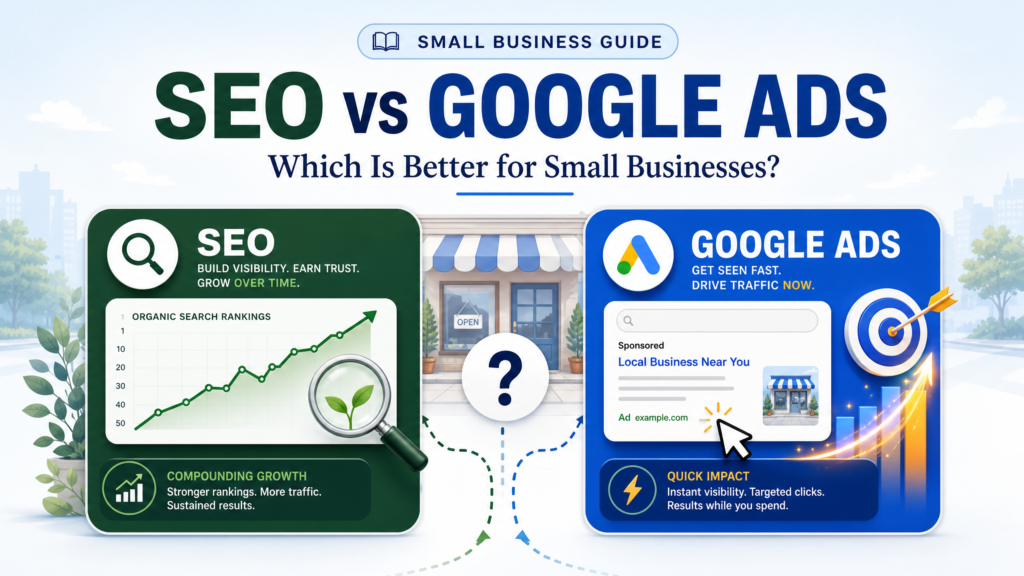
SEO earns organic rankings through website optimization and relevance, while Google Ads provides paid placements through advertising campaigns.
SEO usually takes longer to produce significant results but can create lasting organic visibility. Google Ads can generate traffic much faster but requires continuous advertising expenditure.
| Factor | SEO | Google Ads |
|---|---|---|
| Traffic | Organic | Paid |
| Initial results | Usually slower | Usually faster |
| Long-term value | Strong potential | Depends on ongoing spending |
| Cost model | SEO investment | Paid advertising |
| Visibility | Earned rankings | Paid placements |
| Control | Moderate | High |
| Best suited for | Long-term growth | Immediate visibility and leads |
Neither option is automatically better for every business. The right choice depends on your business objectives and available resources.
4. Evaluate SEO vs PPC for Small Businesses
When comparing SEO vs PPC for small businesses, budget is an important consideration.
SEO requires investment in content, website optimization, technical improvements, link building, tools, and professional expertise. The results can compound over time as your website gains authority and rankings.
PPC advertising requires an ongoing advertising budget. Businesses can control spending by setting daily or monthly limits, but competitive keywords can have higher costs.
SEO can be more sustainable for long-term growth, while PPC can be valuable when a business needs immediate visibility.
For example, a new local business may use Google Ads to generate leads immediately while developing an SEO strategy in the background.
5. Compare SEO vs Google Ads Cost
There is no universal answer to whether SEO or Google Ads is cheaper.
SEO costs can include:
- SEO services
- Content creation
- Website development
- SEO tools
- Technical optimization
- Link-building activities
Google Ads costs can include:
- Ad spend
- Cost per click
- Campaign management
- Landing page development
- Conversion optimization
The cost of Google Ads can vary significantly depending on keyword competition, industry, location, targeting, and campaign quality.
Instead of asking only whether SEO or Google Ads costs less, small businesses should consider:
Which channel can generate the highest return from the available marketing budget?
A cheaper marketing channel is not necessarily better if it produces fewer qualified customers.
6. Measure SEO vs Google Ads ROI
SEO vs Google Ads ROI should be evaluated based on business outcomes rather than traffic alone.
SEO can generate strong long-term returns because pages that achieve good organic rankings may continue attracting visitors without a direct cost for every click. However, SEO requires time, maintenance, and ongoing optimization.
Google Ads provides detailed performance data. Businesses can monitor clicks, conversions, advertising spend, cost per lead, conversion rate, and other campaign metrics.
For example, if a business spends ₹20,000 on advertising and generates customers worth significantly more than that investment, the campaign may be profitable.
Similarly, if SEO generates consistent qualified leads from organic search while reducing dependency on paid advertising, it can provide substantial long-term value.
7. Use SEO and Google Ads for Lead Generation
Both channels can support lead generation, but they target customers differently.
Google Ads can target people who are actively searching for a product or service. This makes it particularly useful for high-intent searches.
SEO can attract users at different stages of the buying journey. Informational content can build awareness, while service and product pages can target customers closer to making a decision.
For example, an accounting firm could use Google Ads for:
- Accountant near me
- Tax consultant for small business
- Business accountant in Delhi
At the same time, its SEO strategy could target:
- How much does an accountant cost?
- Small business tax tips
- How to choose an accountant
This allows the business to reach potential customers at different stages of the customer journey.
8. Choose SEO If You Want Long-Term Growth
SEO may be the better option if your business wants to:
- Build long-term organic visibility
- Generate consistent website traffic
- Reduce dependency on paid advertising
- Establish authority in your industry
- Target informational and commercial keywords
- Strengthen local search visibility
- Build sustainable customer acquisition channels
SEO is particularly useful for businesses that are willing to invest consistently and wait for results to develop.
It is not a shortcut, but successful SEO can become a valuable long-term marketing asset.
9. Choose Google Ads If You Need Immediate Results
Google Ads may be the better option when a business needs:
- Immediate search visibility
- Fast website traffic
- Quick lead generation
- Highly targeted advertising
- Keyword and offer testing
- Measurable campaign data
- Greater control over advertising spend
It can be particularly useful for new businesses that have not yet established strong organic rankings.
For example, a newly launched service business may not rank organically for competitive keywords immediately. Google Ads can help it appear in front of potential customers while its SEO strategy develops.
10. Consider a Combined SEO and Google Ads Strategy
For many small businesses, the best strategy is not choosing between SEO and Google Ads. Instead, both channels can work together.
A business could use Google Ads to generate immediate traffic and leads while investing in SEO to build long-term organic visibility.
For example:
- Use Google Ads for high-intent commercial keywords.
- Optimize service pages for organic search.
- Create useful educational content.
- Track leads and conversions from both channels.
- Identify profitable keywords through paid campaigns.
- Use performance data to improve SEO content.
- Gradually adjust the marketing budget based on ROI.
This approach allows businesses to address both short-term and long-term marketing objectives.
A Practical SEO vs Google Ads Strategy for Small Businesses
If you are unsure where to start, focus on your business objectives first.
- Define your monthly marketing budget.
- Identify your most valuable products or services.
- Research relevant commercial keywords.
- Determine how quickly you need leads.
- Launch Google Ads when immediate visibility is important.
- Build SEO foundations for long-term organic growth.
- Optimize your website for conversions.
- Track traffic, leads, conversions, and customer acquisition costs.
- Compare performance between organic and paid channels.
- Reallocate your budget based on actual business results.
Do not judge SEO or Google Ads solely by impressions or clicks. The ultimate goal is to generate qualified customers and profitable growth.
Final Thoughts
So, which is better for small businesses: SEO or Google Ads?
If your priority is fast visibility, immediate traffic, and quick lead generation, Google Ads can be the better starting point.
If your goal is long-term organic traffic, authority, and sustainable growth, SEO is generally the stronger investment.
For many small businesses, combining both strategies can provide the most balanced approach. Google Ads can generate short-term opportunities while SEO builds a stronger organic foundation for the future.
Ultimately, the best strategy depends on your budget, competition, industry, customer journey, and business goals. Instead of focusing only on rankings or clicks, measure qualified leads, conversions, customer acquisition cost, and ROI to determine which channel is genuinely contributing to business growth.
Frequently Asked Questions
Is SEO better than Google Ads for small businesses?
SEO can be better for small businesses focused on long-term organic traffic, brand authority, and sustainable growth. Google Ads may be more suitable when a business needs immediate visibility and leads. The right choice depends on budget, competition, and business goals.
Is Google Ads cheaper than SEO?
Neither option is always cheaper. SEO requires investment in content, website optimization, and ongoing SEO activities, while Google Ads requires continuous advertising spend. Small businesses should compare the cost of each channel against the qualified leads, conversions, and revenue it generates.
How long does SEO take compared with Google Ads?
Google Ads can start generating visibility and traffic shortly after a campaign is launched and approved. SEO generally takes longer because websites need time to improve their rankings and authority. However, successful SEO can provide long-term organic visibility without paying for every click.
Can a small business use SEO and Google Ads together?
Yes. Using SEO and Google Ads together can be an effective strategy. Google Ads can provide immediate traffic and lead generation, while SEO builds long-term organic visibility. Businesses can also use data from paid campaigns to identify valuable keywords for their SEO strategy.
Which is better for lead generation: SEO or Google Ads?
Google Ads can be highly effective for immediate lead generation because businesses can target users actively searching for specific products or services. SEO can generate leads over the long term by attracting users through informational, commercial, and local search queries. The better option depends on the business and customer journey.
Should a new business invest in SEO or Google Ads?
A new business can benefit from both. Google Ads can help generate immediate visibility while the business builds its organic presence through SEO. If the marketing budget is limited, prioritize high-intent keywords and measure conversions carefully before increasing spending.
Does SEO provide a better ROI than Google Ads?
SEO can provide strong long-term ROI because organic rankings can continue generating traffic without a direct cost for every click. Google Ads can also deliver excellent ROI when campaigns are properly targeted and optimized. Businesses should compare qualified leads, conversions, customer acquisition costs, and revenue rather than looking at traffic alone.