
Search no longer ends with ten blue links. People now ask conversational questions and get a finished answer from Google AI Overviews, AI Mode, ChatGPT, Perplexity, or a voice assistant. If your content is not the one being extracted or cited, you are invisible at the exact moment a buyer decides.
At MarketingPath, we build and optimize websites and content for service businesses, from clinics to culinary institutions, so we see this shift in client search data every week. Two acronyms keep coming up in those conversations: AEO and GEO. This guide explains the AEO vs GEO difference in plain terms, shows how AEO vs SEO vs GEO fit together, and gives you a practical playbook you can apply this week.
What Is the Difference Between AEO and GEO?
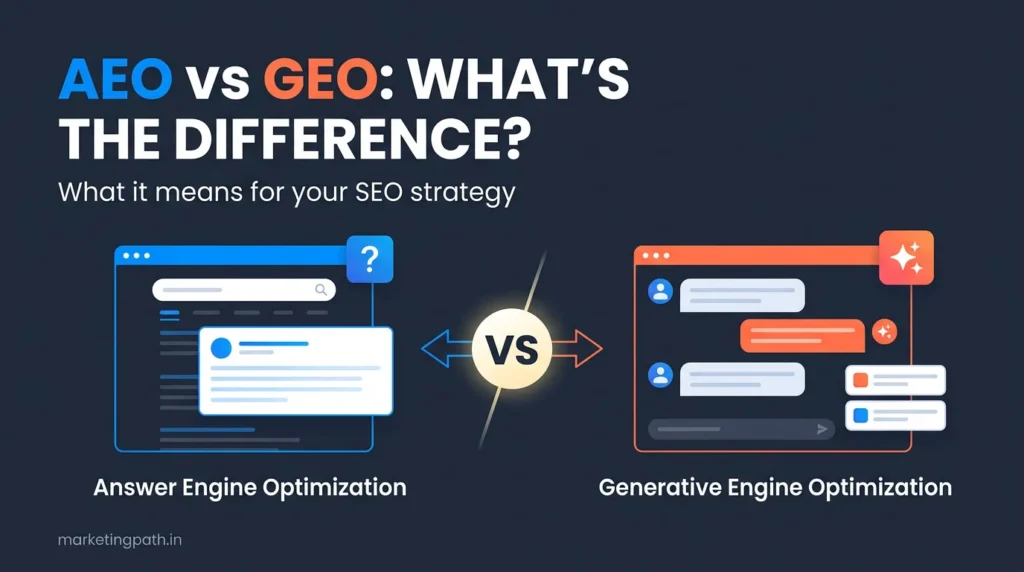
The AEO vs GEO difference comes down to the outcome. Answer Engine Optimization (AEO) structures content so an engine can extract one clean, direct answer, like a featured snippet or voice reply. Generative Engine Optimization (GEO) builds authority so AI systems like ChatGPT, Perplexity, and Google AI Overviews cite your brand inside a synthesized answer.
AEO vs GEO at a glance
| Factor | AEO (Answer Engine Optimization) | GEO (Generative Engine Optimization) |
| Core goal | Be the single extracted answer | Be a cited source inside a generated answer |
| Typical surfaces | Featured snippets, People Also Ask, voice assistants, answer cards | AI Overviews, AI Mode, ChatGPT, Perplexity, Gemini, Copilot |
| How the engine uses you | Lifts your passage (extraction) | Blends your facts with other sources (synthesis) |
| Best content type | Definitions, FAQs, how-to steps, short direct answers | Original data, expert opinion, comparisons, comprehensive guides |
| Key tactics | Answer-first paragraphs, question headings, FAQ and HowTo schema | Entity clarity, citations, third-party mentions, fact density, freshness |
| Success metric | Snippet ownership, voice answers, answer-box impressions | Citation rate, brand mentions, share of voice in AI answers |
| Origin | Grew from featured-snippet and voice-search practice | Named in 2023 academic research on generative engines |
One nuance worth knowing: many practitioners treat the two as largely the same job under different labels, because a citation needs both a retrievable page (the GEO lens) and an extractable answer (the AEO lens). The research paper that coined GEO came from Princeton, Georgia Tech, the Allen Institute for AI, and IIT Delhi, first submitted in November 2023, and it tested visibility tactics on a benchmark called GEO-bench. Interest is real: one analysis reported about 54.3K global searches for “Generative Engine Optimization” in January 2026, versus roughly 30K for “Answer Engine Optimization”.
What Is Answer Engine Optimization (AEO)?
Answer Engine Optimization (AEO) is the practice of formatting content so search and AI engines can lift a concise, accurate answer from your page. It targets featured snippets, People Also Ask boxes, voice assistants,s and zero-click answer cards, and relies on question-based headings, answer-first paragraphs, hs and structured data.
Core AEO building blocks
- Question-based headings that mirror conversational queries.
- The inverted pyramid: the direct answer in the first sentence, supporting detail after.
- 40-60 word answer blocks that are clean enough to be read aloud.
- FAQ, HowTo, and Article schema (structured data) that labels each answer unit.
- Scannable formatting: short lists, tables, and definition boxes.
AEO’s lineage runs through featured snippets and voice search, so it is the most direct extension of work SEOs already do.
What Is Generative Engine Optimization (GEO)?
Generative Engine Optimization (GEO) is the practice of making your content retrievable, trustworthy, and quotable for AI systems that write original answers from multiple sources, such as ChatGPT, Perplexity, Gemini, i and Google AI Overviews. Success is measured by citations and brand mentions inside the generated response, not just rankings.
Generative engines typically use retrieval-augmented generation (RAG): they fetch relevant documents first, then write an answer grounded in them. That changes what “winning” looks like.
Core GEO building blocks
- High information density: original statistics, definitions, expert quotes, and specifics a model wants to reuse.
- Entity clarity: your brand, authors, and products described consistently so a model links them to the right topic.
- Third-party corroboration: brand mentions on reputable sites, reviews, directories, and publications.
- Topical authority: deep, interlinked coverage of a subject rather than isolated posts.
- Freshness and accuracy: updated facts with visible dates and sources.
How Does AEO Differ From Traditional SEO?
AEO differs from traditional SEO in its goal and format. SEO earns a ranked link and a click. AEO earns the extracted answer itself, often without a click. It prioritizes concise answer-first passages, question headings, and schema, while SEO covers the wider system of crawlability, relevance, links, and authority that AEO still depends on.
AEO vs SEO vs GEO: Side-by-Side Comparison
| Dimension | Traditional SEO | AEO | GEO |
| Primary goal | Rank pages and earn clicks | Be the extracted direct answer | Be cited inside an AI-written answer |
| Unit of optimization | Page and keyword | Question-and-answer passage | Entity, claim and source across the web |
| Main signals | Relevance, links, technical health, E-E-A-T | Answer clarity, structure, schema | Authority, corroboration, extractability, freshness |
| Where you appear | Blue-link results | Snippets, voice, answer boxes | AI Overviews, AI Mode, ChatGPT, Perplexity |
| Click behavior | Click to your site | Often zero-click | Variable; citation links drive some visits |
| Measure with | Rankings, clicks, conversions | Snippet wins, impressions | Citations, mentions, referral traffic |
The simplest mental model: SEO gets you found, AEO gets you quoted, GEO gets you trusted and recommended. They are layers of one stack, not rival strategies.
Is GEO Replacing SEO?
No, GEO is not replacing SEO. AI search systems still discover, retrieve, and rank pages using search fundamentals, so crawlability, relevance,e and authority remain the foundation. AEO and GEO are layers added on top of SEO. Google’s publisher guidance has reportedly framed optimizing for its AI features as an extension of established SEO.
Why SEO still matters in the AI era
- Pages that cannot be crawled or indexed cannot be retrieved or cited.
- Retrieval systems lean on relevance and authority signals that SEO builds.
- AI answers still link out, and ranking well tends to correlate with being retrieved.
- Brand demand created by SEO and PR increases the odds of being mentioned by name.
What has changed is the scorecard. A page can influence a buyer without earning a click, so rankings and traffic alone no longer tell the whole story.
How to Optimize Content for AI Search Engines
To optimize content for AI search engines, keep your site crawlable, answer questions in the first sentence under each heading, add structured data, show real author expertise, and build brand mentions on trusted third-party sites. Then refresh content regularly and track citations across ChatGPT, Perplexity, and Google AI features.
Step 1: Fix the Technical Foundation
- Make sure important pages are indexable and load fast on mobile.
- Do not block AI and search crawlers you want visibility from in robots.txt.
- Keep key content in HTML, not hidden behind scripts or tabs that bots cannot read (content accessibility).
- Use a clean heading hierarchy: one H1, logical H2s and H3s.
Step 2: Write Answer-First Content
- Turn real customer questions into H2 or H3 headings.
- Put the 40-60 word answer directly under the heading.
- Follow with proof: data, an example, a table,e or a step list.
Example: before and after (dental clinic service page)
| Before | After |
| A long intro about the clinic’s history before mentioning root canal treatment | An H2 reading “How long does a root canal take?” followed by a two-sentence direct answer, then a table of typical visit counts by tooth type, then the dentist’s credentials |
The second version serves a snippet, a voice answer,r and an AI summary from the same block.
Step 3: Add Structured Data
Use schema markup that matches visible content: Article, FAQPage, HowTo, Organization, Person (for authors), LocalBusiness, and Product where relevant. Structured data does not guarantee inclusion, but it removes ambiguity about what each block means.
Step 4: Strengthen E-E-A-T Signals
- Add named authors with real credentials and a bio page.
- Show first-hand experience: original photos, case notes, process screenshots, results.
- Cite primary sources and link to them.
- Display publish and last-updated dates, and actually update them.
Step 5: Build Entity and Topical Authority
- Describe your brand the same way everywhere: website, Google Business Profile, LinkedIn, directories.
- Cover a topic as a cluster: one pillar guide plus supporting pages that answer every sub-question.
- Interlink the cluster with descriptive anchor text.
How Can a Website Appear in AI-Generated Answers?
A website appears in AI-generated answers when it is indexable, directly relevant to the query, easy to extract from, and corroborated elsewhere on the web. Publish answer-first, fact-dense pages, mark them up with schema, and earn mentions from authoritative sources so retrieval systems trust and cite you.
Checklist: content that gets cited
- Opens each section with a definitive, standalone answer.
- Contains specific, verifiable facts instead of generic advice.
- Uses tables, bullets, and definition boxes for easy chunking.
- Names the brand next to the concept it should own (for example, “MarketingPath’s AEO audit checklist”).
- Shows author expertise and dated sources.
- Is mentioned and linked from other credible sites.
What to avoid: keyword stuffing, thin pages written only for bots, unsourced statistics, and burying the answer under long introductions. Generative engines favor material with clear opinions and evidence over vague, all-purpose copy.
How to Improve Brand Visibility in AI Search
To improve brand visibility in AI search, make your brand an unmistakable entity: consistent name, description, and profiles everywhere, strong topical content, and frequent mentions on credible third-party sites. AI models cite brands they can verify, so pair on-site expertise with reviews, directories, publications, and community discussions.
Brand visibility actions that compound
- Own your definitions. Publish the definitive explainer for your category and use consistent phrasing.
- Earn third-party mentions. Guest articles, expert quotes, podcasts, industry lists, and partner pages.
- Collect real reviews on Google Business Profile and relevant platforms.
- Publish original data. Surveys, benchmarks,s or anonymized client findings are what AI summaries quote.
- Create comparison and alternatives pages that fairly answer “X vs Y” queries.
- Keep facts current so models do not repeat outdated details about you.
How to Measure AEO and GEO Performance
Measure AEO and GEO with a blend of Google Search Console, Google Analytics 4 (GA,4) and manual AI prompt testing. Track question-style queries, impressions, and snippet wins in Search Console, AI referral traffic in GA4, and brand citations or mentions by sampling a fixed prompt set across ChatGPT, Perplexity, Gemini, i and Google AI features.
| Metric | Where to find it | What it tells you |
| Question-style queries (who, what, how, why) | Google Search Console, Performance report with a query regex filter | Conversational demand and AEO opportunity |
| Impressions vs clicks on answer-style pages | Google Search Console | Rising impressions with flat clicks often signals zero-click exposure |
| AI referral sessions | GA4, Traffic acquisition filtered by source (for example chatgpt.com, perplexity.ai, gemini.google.com, copilot.microsoft.com) | Visits that actually come from AI tools |
| Branded search growth | Google Search Console | Whether AI exposure builds brand demand |
| Citation and mention rate | Manual or tool-based prompt tracking | How often you are named or linked in AI answers |
| Answer accuracy | Manual review | Whether AI describes your brand correctly |
Practical measurement tips
- Keep a fixed list of 20-50 priority prompts and test them monthly, recording engine, date, and result. Results vary by engine and by day, so look for trends, not single snapshots.
- Remember Google may not break out AI feature performance separately in Search Console, so triangulate with the other signals.
- Create a GA4 exploration or custom channel group for AI referrals so the trend is visible.
Frequently Asked Questions
What is the difference between AEO and GEO?
AEO optimizes content so an engine can extract one direct answer, such as a featured snippet or voice reply. GEO optimizes your brand and content so generative AI systems cite you within a synthesized, multi-source answer. AEO is about being the answer; GEO is about being a trusted source the AI relies on.
Do I need both AEO and GEO?
Yes, in practice. The work overlaps and compounds: answer-first structure and schema (AEO) make your content extractable, while authority, entities, and third-party mentions (GEO) make it retrievable and trusted. Build on a solid SEO foundation first.
Does schema markup guarantee I will appear in AI answers?
No. Structured data helps engines understand your content, but inclusion depends on relevance, quality, authority,y and the engine’s own selection logic.
How long does it take to see results from AEO and GEO?
Snippet and structure improvements can show up within weeks of recrawling. Authority-driven GEO gains from mentions and topical depth usually take months. Track leading indicators such as impressions and citations, not only traffic.
Key Takeaways
- AEO = be the extracted answer. GEO = be the cited source inside a generated answer. SEO = the foundation both depend on.
- Lead every section with a 40-60 word direct answer, then add proof.
- Build entity clarity, topical authority, and third-party mentions so AI systems can verify and recommend you.
- Measure beyond rankings: question queries, AI referrals, citations,s and brand mentions.
- Do not abandon SEO. Layer AEO and GEO on top of it.