
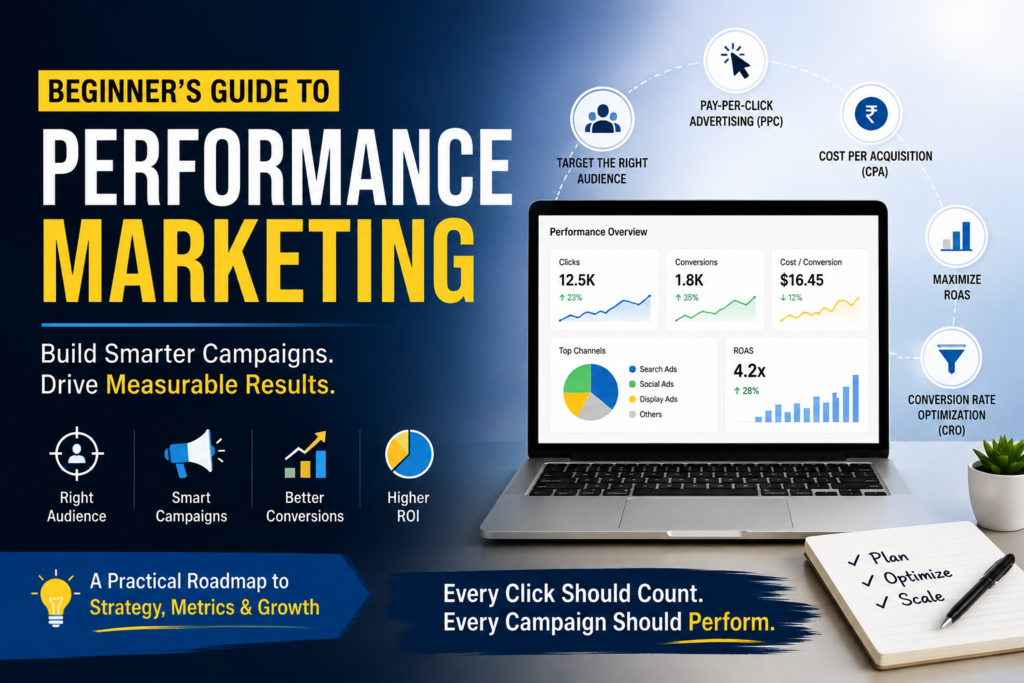
Performance marketing sounds simple: spend money on advertising, track results, and improve what works. In practice, it is far more complex. A campaign can generate thousands of clicks and still lose money. A low-cost lead can turn out to be unqualified. An ad with a high click-through rate may still contribute very little to actual revenue. That is why performance marketing is not just about running campaigns—it is about building a measurable system where your budget, audience, offer, channels, landing pages, and conversion data work together. This guide helps you move beyond the basics and understand how to strategically plan, execute, and scale performance marketing for real business outcomes.
Before You Spend Another Dollar, Define What “Performance” Means
Many businesses fail because they launch ads without defining success. For one business, success may mean 100 qualified leads. For another, it may mean 500 profitable sales. Your objective determines everything.
- Lead generation: Focus on qualified leads and cost per lead
- Ecommerce: Focus on purchases, revenue, and ROAS
- SaaS: Focus on trials, subscriptions, and CAC
- Local services: Focus on enquiries, bookings, and conversions
- Apps: Focus on installs, registrations, and active users
Clicks and impressions only show activity, not business growth.
Choose the Right KPI for Your Goal
Your KPI should answer one question: Is this marketing activity helping the business grow?
Key metrics include:
- CPC: Cost per click
- CPA: Cost per acquisition
- Conversion rate: Visitor-to-action efficiency
- ROAS: Revenue per ad spend
- ROI: Overall profitability
A campaign should never be judged using the wrong metric. For example, ROAS is not always relevant for B2B lead generation, just as clicks alone are not enough for ecommerce success.
The Performance Marketing Funnel: Where Money Is Made or Lost
Performance marketing is not just ads—it is a full journey:
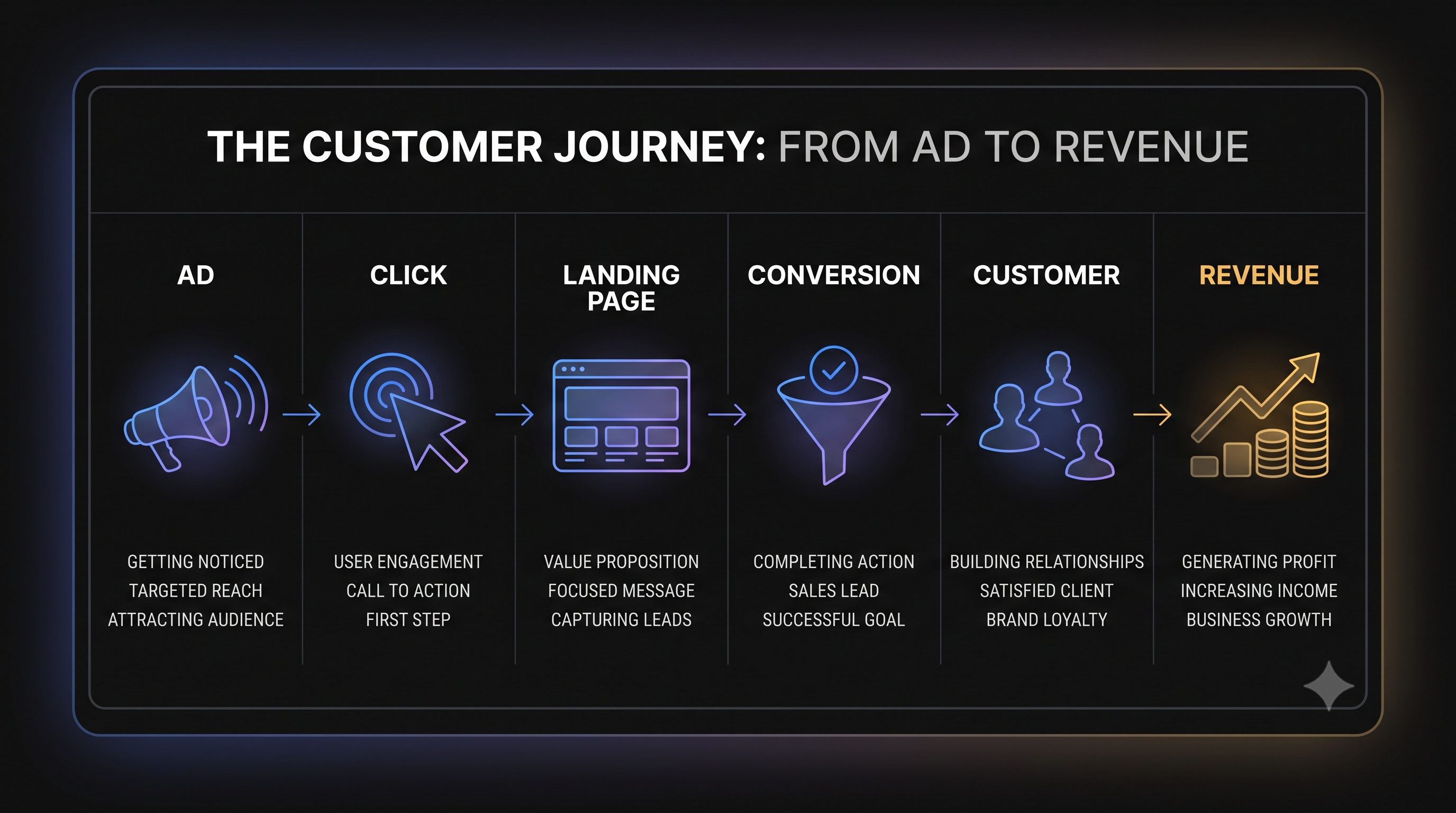
Common problems include:
- Misaligned landing page
- Weak offer
- Complicated checkout
- Poor audience targeting
- Unclear CTA
- Slow page speed
- Broken tracking
This is where conversion rate optimization (CRO) becomes critical. Instead of chasing more traffic, CRO improves how many visitors actually convert.
Traffic Is Not Performance
Cheap traffic can be misleading. For example:
- Campaign A: 1,000 clicks at ₹10 CPC
- Campaign B: 500 clicks at ₹20 CPC
Campaign A looks better on cost. But if Campaign A generates 5 customers and Campaign B generates 25, Campaign B is clearly superior. Real performance is measured by outcomes, not clicks.
Choosing the Right Performance Marketing Channel
No single channel works for every business. The right choice depends on intent, audience, budget, and goals.
Google Ads
Best for high-intent searches where users already know what they want.
Ideal for:
- Local services
- B2B services
- Ecommerce products
- High-intent keywords
Example: “emergency plumber near me”
Paid Social (Meta, LinkedIn, etc.)
Best for demand creation and audience targeting.
Ideal for:
- Product discovery
- Retargeting
- Brand awareness
- Visual products
- Content-driven campaigns
Affiliate Marketing
Works when partners promote your product for commission.
Best when:
- Product demand is strong
- Tracking is reliable
- Commission structure is attractive
Retargeting
Re-engages users who didn’t convert the first time.
Use for:
- Website visitors
- Abandoned carts
- Product viewers
- Past customers
Retargeting must add value, not just repeat ads.
Don’t Spread Budget Too Thin
Start with one strong channel. Once it performs consistently, expand. Early-stage diversification often leads to confusion and wasted spend.
Build a Performance Marketing Strategy Around Numbers
A strong strategy starts before ads go live. Instead of asking “Which platform should we use?”, ask “What does profitability look like?”
Understand Customer Economics
Key factors:
- Average order value
- Gross margin
- Customer lifetime value
- Break-even CPA
- Conversion rate
A ₹1,000 acquisition cost may be profitable for one business and disastrous for another.
Set a Target CPA
Your target CPA defines how much you can spend to acquire a customer profitably. It should always be based on real business economics, not assumptions.
Define Conversion Hierarchy
Not all conversions are equal:
- Primary conversions (sales, leads)
- Secondary conversions (sign-ups, inquiries)
- Micro conversions (clicks, downloads)
Build a Measurement System
Before launching, define:
- What will be tracked
- Where data comes from
- Which conversions matter
- How success is measured
- How scaling decisions are made
Without this, optimization becomes guesswork.
Create Campaigns That Convert
Even perfect targeting cannot fix a weak offer. Every campaign must answer:
What is the offer? Why should the user care? Why act now?
Start With the Offer
Strong offers include:
- Discounts or pricing advantage
- Free consultation or trial
- Bundles or bonuses
- Strong guarantees
- Time-sensitive incentives
Write Customer-Focused Ads
Good ads focus on problems and outcomes, not company descriptions.
Instead of:
“We provide SEO services”
Use:
“Turn search traffic into qualified leads with SEO built for measurable growth.”
Align Landing Pages With Ads
Your landing page must continue the ad’s promise:
Ad → Promise → Landing Page → Action
Key elements:
- Clear headline
- Strong value proposition
- Trust signals
- Testimonials
- Simple CTA
- Fast loading speed
Metrics That Actually Matter
CPC
Cost per click. Useful, but not a success metric alone.
CTR
Shows engagement. Low CTR may indicate weak messaging or poor targeting.
Conversion Rate
Measures how well traffic converts into action.
CPL & CPA
Show cost efficiency of leads or customers.
ROAS
Measures revenue vs ad spend but ignores other business costs.
ROI
The most complete measure of profitability.
How to Optimize Campaigns
Performance marketing improves through continuous testing.
Identify the Core Problem
- Low CTR → creative issue
- High CPC → targeting issue
- Low conversion rate → landing page issue
- High CPA → funnel issue
Test One Variable at a Time
Test:
- Headlines
- Creatives
- Audiences
- Offers
- Landing pages
Know When to Stop
If a campaign consistently underperforms after testing, pause it. Protect future budget efficiency.
Know When to Scale
Scale only when:
- Conversions are stable
- CPA is profitable
- Tracking is reliable
- Demand is consistent
Performance Marketing Examples
Local Business
Ad → Visits → Leads → Customers → Revenue
Focus on lead quality, not just volume.
Ecommerce
Ad → Clicks → Purchases → Revenue → ROAS
Focus on profitability, not just sales.
SaaS
Ad → Trial → Usage → Subscription
Focus on paying users, not signups.
Why Campaigns Fail
Even good ads can fail due to:
- Weak offer
- Wrong audience
- Poor landing page
- Bad tracking
- Low-quality leads
- Poor follow-up
- Vanity metric optimization
Always analyze the full funnel, not just ads.
How to Scale Performance Marketing
Scaling means increasing profit, not just spend.
Scale Gradually
Monitor CPA, ROAS, and conversion rates.
Expand Audiences
- New segments
- New geographies
- Lookalike audiences
Expand Creatives
- New hooks
- New formats
- New messaging angles
Diversify After Stability
Only expand channels after one channel is consistently profitable.
How AI Is Changing Performance Marketing
AI helps with:
- Ad copy
- Audience insights
- Reporting
- Optimization
- Creative ideas
But strategy still requires human judgment:
- Customer psychology
- Offer design
- Business economics
- Brand positioning
AI accelerates execution, not decision-making.
Performance Marketing Checklist
Before Launch
- Define goal
- Set KPIs
- Identify audience
- Prepare landing page
- Set tracking
During Campaign
- Monitor CTR, CPC, CPA
- Test creatives
- Analyze conversions
- Track lead quality
Before Scaling
- Confirm profitability
- Validate tracking
- Ensure stable performance
Final Takeaway
Performance marketing is not about running ads—it is about building a system that consistently turns spend into profit. The strongest campaigns are not the ones with the most clicks, but the ones that generate predictable, scalable business outcomes. Focus on measurement, optimization, and profitability, and scale only when the data supports it.
Frequently Asked Questions
1. What is performance marketing in simple terms?
Performance marketing is a results-focused approach to digital advertising where campaigns are measured against specific actions such as clicks, leads, sales, signups, or conversions. Businesses use performance data to understand what works and optimize their marketing spend.
2. How does performance marketing work?
Performance marketing works by setting a measurable goal, choosing the right audience and advertising channel, launching a campaign, tracking conversions, and optimizing based on the results. The process typically involves continuous testing to improve efficiency and profitability.
3. What are the main types of performance marketing?
The main types include pay-per-click (PPC) advertising, paid social media advertising, affiliate marketing, influencer marketing, email marketing, display advertising, and retargeting. The right channel depends on the business goal, audience, and customer journey.
4. What are the most important performance marketing metrics?
Important metrics include cost per click (CPC), click-through rate (CTR), cost per lead (CPL), cost per acquisition (CPA), conversion rate, return on ad spend (ROAS), and return on investment (ROI). The most useful metric depends on the campaign’s specific objective.
5. How do I start performance marketing as a beginner?
Start by defining one clear business objective, identifying your target audience, selecting an appropriate advertising channel, setting a realistic budget, and configuring conversion tracking. Launch a focused campaign, analyze the data, and optimize it before increasing your budget.
6. Is performance marketing suitable for small businesses?
Yes. Performance marketing can be useful for small businesses because campaigns can be targeted toward specific audiences and measured against defined outcomes. Starting with a focused campaign and a manageable budget can help businesses learn what generates valuable results before scaling.
7. How long does it take to see results from performance marketing?
The timeframe varies depending on the advertising channel, budget, competition, audience, offer, and conversion cycle. Some campaigns can generate initial results quickly, while others require several rounds of testing and optimization before consistent performance can be established.
